How to Choose a Deep Tissue Massage Therapist Near Felixstowe
If you have been searching for deep tissue massage near Felixstowe, you already know the feeling.
That same tight band across your shoulders every morning. The stiff neck that never quite loosens up. The lower back that aches through every meeting, every school run, every hour at the desk.
You have probably tried heat packs, foam rollers, maybe even a gentler massage — and got a day of relief before it all crept back in.
As a Thai massage therapist, the most common thing I hear from new clients “I did not realise how bad it had got until it finally started to ease.”
Chronic tension sneaks up on you. You adapt to it, work around it, and eventually start to think it is just how your body feels. It does not have to be.
This guide explains what deep tissue massage actually does, why it works for the kind of tension that builds up from modern life, what a proper session looks like from start to finish, and how to choose a good therapist close to Felixstowe.
By the end, you should have a clear picture of whether this is the right next step for you.
Why Stubborn Neck, Shoulder and Back Tension Is So Common Around Felixstowe
A lot of people living and working in and around Felixstowe spend long hours driving, working at a screen, or doing repetitive physical tasks — dockwork, logistics, retail, care work. All of these load the same muscle groups in the same way, day after day.
The neck shortens at the front. The upper trapezius grips to hold the head up. The muscles along the thoracic spine brace to compensate for a forward-leaning posture. Over months and years, this becomes the body’s default state.
What you feel as a “knot” is usually a combination of muscle fibres that have shortened and stopped moving properly, areas where the fascia, the connective tissue wrapped around and between muscles, has thickened or adhered to adjacent layers, and sometimes a trigger point…a hypersensitive spot within a taut band of muscle that refers pain elsewhere when pressed.
Trigger points in the upper trapezius, for example, commonly refer pain up the side of the neck and into the temple, which is why so many tension headaches seem to start in the shoulders.
Lighter massage can soothe the surface and calm the nervous system, which is genuinely useful. But when the problem sits in the deeper muscle layers and fascia, lighter work tends to slide over it rather than change it. That is where deep tissue massage has the advantage.
What Deep Tissue Massage Actually Does
Deep tissue massage is not simply a harder version of a relaxation massage. It is a different approach entirely, focused on changing the structure and behaviour of deeper muscle and connective tissue rather than primarily soothing the surface.
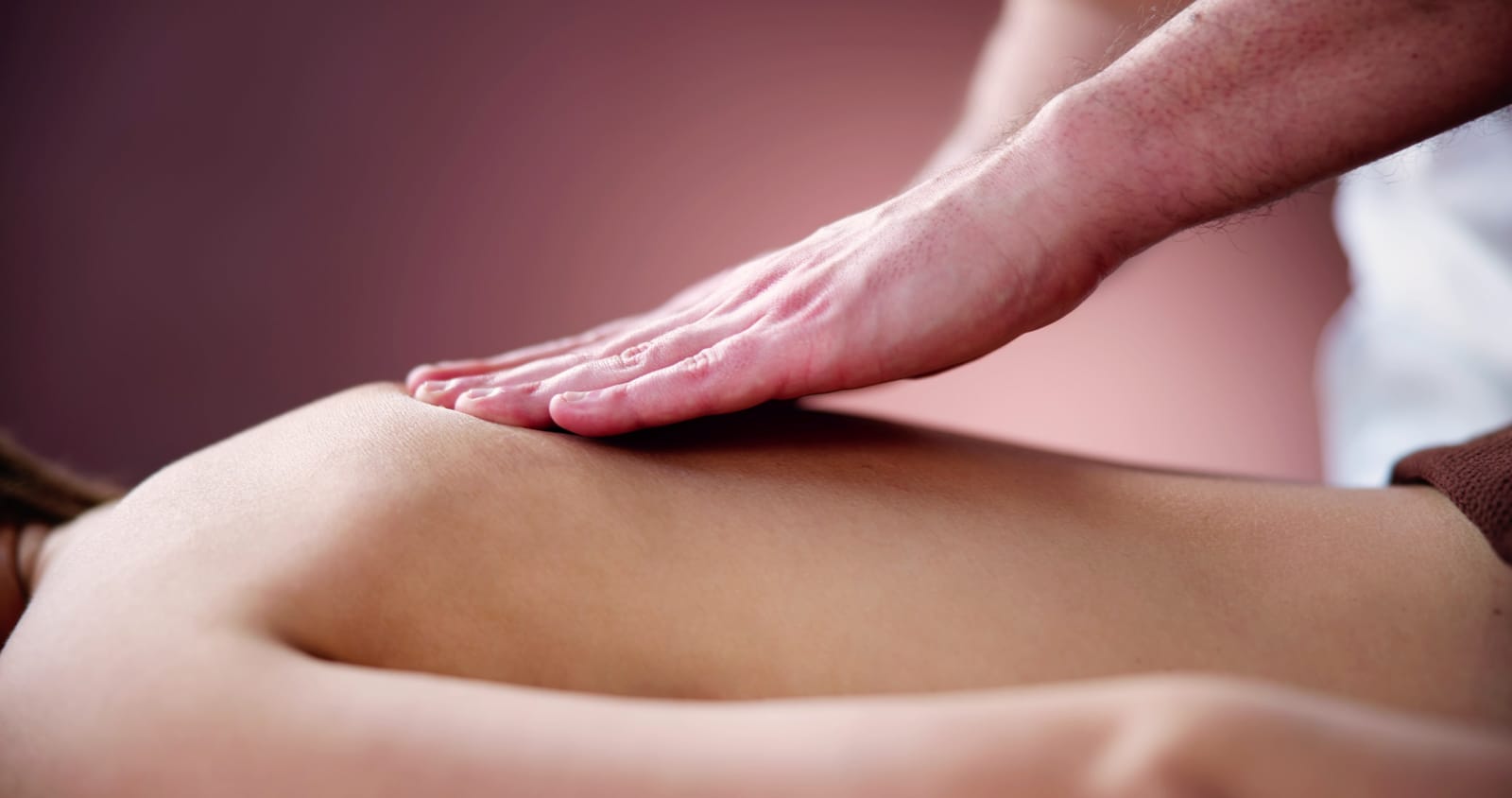
The therapist uses slow, deliberate strokes that follow the direction of the muscle fibres, applying firm pressure through fingers, thumbs, knuckles, forearms or elbows depending on the area.
The pace is slower than a relaxation massage because the aim is to sink through the outer layers progressively. When a tight band or adhesion is found, the therapist will work that specific area rather than moving straight through it.
Here is what is actually happening during that process:
- Adhesions are broken down. These are areas where muscle fibres or layers of fascia have bonded together abnormally, reducing movement and sometimes irritating local nerves. Sustained pressure helps separate stuck layers so the tissue can glide freely again.
- Blood flow is improved. Tight muscle tissue has reduced circulation. Deep work creates a mechanical effect that brings fresh, oxygenated blood into the area and helps clear metabolic waste products that contribute to that constant dull ache.
- Trigger points are addressed. Sustained compression on a trigger point, held for several seconds, can reduce its activity and ease the referred pain pattern it creates.
- The nervous system is calmed. Even though deep tissue work feels intense in the moment, it activates the parasympathetic (rest-and-digest) branch of the nervous system. This is why clients often feel an unexpected sense of calm after a firm session.
A well-delivered deep tissue massage should feel intense but never agonising. You should be able to breathe normally throughout. If the pressure tips into sharp, breathtaking pain, that is too much, and a good therapist will always adjust.
Experienced therapists often describe this as a “good hurt,” meaning strong pressure that feels like it is reaching exactly what needs to be reached.
How Thai Massage Techniques Make Deep Tissue Work More Effective
At Baan Thai Wellness in Ipswich, just a short drive from Felixstowe, deep tissue work is combined with traditional Thai massage methods. This matters because the two approaches complement each other in ways that purely Western deep tissue work cannot replicate on its own.
Traditional Thai massage works along sen lines, which are pathways in the body that correspond broadly to areas of muscular and fascial connection.
Acupressure applied along these lines can reduce tension across an entire muscle group rather than one localised spot. Instead of treating the knot in isolation, you are also addressing the whole chain of tension that feeds into it.
The passive stretching element of Thai massage is equally valuable. When muscles have been chronically tight, they shorten over time.
Passive stretching is where the therapist moves your body through a range of motion while you stay completely relaxed, and it helps restore length in a way that is very difficult to achieve through self-stretching alone.
The hips, shoulders, thoracic spine and hip flexors are the areas that lock up most from desk-based work and driving, and Thai stretching addresses all of them.
Research into traditional Thai massage has found reductions in perceived pain and anxiety levels alongside improvements in overall wellbeing following treatment. The combination of rhythmic pressure, supported movement and focused bodywork appears to have measurable effects beyond the purely physical.
What to Expect at Your Deep Tissue Massage Session
Knowing what will happen before you arrive makes a real difference to how much you get from the session. Here is how a typical appointment at Baan Thai Wellness unfolds.
The Consultation
Before any hands-on work, your therapist goes through your health history and current concerns. This includes any medical conditions, recent injuries or operations, medications and the specific areas causing you problems.
This information shapes everything that follows. Deep tissue massage is not appropriate in every circumstance.
It is generally avoided directly over areas of acute inflammation, recent fractures, open wounds, active skin infections or blood clots.
Your therapist will establish whether deep work is suitable on that particular day. This is not overcaution; it is professional practice.
The Treatment
Sessions typically begin with lighter, broader strokes to warm the tissue before the deeper work begins. Going straight into deep pressure on cold, tight muscle is counterproductive.
As the tissue warms and responds, the therapist works progressively deeper using palms, thumbs, forearms and elbows as needed. Thai acupressure points are worked throughout, and assisted stretches are introduced where appropriate.
You stay in communication with your therapist throughout the session, not just at the start. Pressure, position and focus can all be adjusted at any point. Some sessions at Baan Thai Wellness also incorporate warm herbal compresses.
The heat helps the superficial muscles relax more quickly, which allows the therapist to reach the deeper layers with less force. This makes the treatment both more comfortable and more effective.
After the Session
Some tenderness in the areas worked on is normal, particularly after your first session or when especially dense tissue has been addressed.
This usually settles within 24 to 48 hours and is typically followed by a feeling of openness and ease in those same areas. Drinking plenty of water helps your body process and clear the metabolic waste released from treated tissue.
Your therapist will suggest specific stretches and postural adjustments based on what was found during your session. Small things…screen height, chair position, how you hold your phone…all feed into the tension patterns that bring people through the door in the first place.
Ready to Find Real Relief?
Stubborn tension in your neck, shoulders and back does not have to be a permanent feature of your life.
When the deeper muscle layers and fascia are the problem, deep tissue massage, particularly when combined with Thai acupressure and assisted stretching, can make changes that lighter approaches simply cannot reach.
If you have been carrying this kind of tension and want to understand what your body could feel like without it, booking a session at Baan Thai Wellness in Ipswich is a practical next step.
The consultation process means your session is shaped around your specific situation, not a standard routine.
Your tension may need more than a light touch. With the right therapist, that is exactly what you will get.
Who Is Deep Tissue Massage Right For?
Deep tissue massage tends to work best for people carrying chronic neck, shoulder or lower back tension from desk work, driving or repetitive physical tasks.
It is also well suited to anyone recovering from a soft tissue injury once the acute phase has passed, or those dealing with tension headaches that originate in the upper back and neck.
It is worth being clear that it is not a replacement for medical investigation of structural spinal problems or nerve issues.
If you have unexplained numbness, tingling or sudden changes in your symptoms, your GP or a physiotherapist should be your first call.
A good massage therapist will tell you the same thing.