Deep Tissue Massage in Ipswich for Lower Back Tightness
That nagging pull after a long day at your desk, the dull ache when you stand up from the sofa, the stiffness when you bend to pick something up.
After a while it stops feeling like a one-off strain and starts to feel like your new normal.
Lower back tightness has a particular way of creeping into everything. It makes work harder, turns simple things like driving or lifting children into something you have to think twice about, and quietly drains your energy even on days when nothing particularly demanding has happened.
Deep tissue massage in Ipswich for lower back tightness at Baan Thai Wellness is built around working on the actual source of that discomfort rather than softening the surface and hoping the relief lasts.
If your lower back pain is sudden, severe, or accompanied by numbness, weakness, or any changes to bladder or bowel function, speak with your GP before booking any massage.
Which Muscles Are Usually Involved in Lower Back Tightness
Lower back tightness is rarely just one muscle.
It is usually a pattern of several structures that have shortened, tightened or developed adhesions in response to repetitive strain, prolonged sitting, poor posture, old injury, or a combination of all of these.
The muscles most commonly involved are the quadratus lumborum, a deep muscle on each side of the lumbar spine that is one of the primary stabilisers of the lower back and one of the first to tighten when someone sits for long periods.
When the quadratus lumborum shortens on one side, it can create an uneven pull on the pelvis that is felt as a persistent ache or a sense that the back is never quite symmetrical.
The gluteal muscles are almost always part of the picture too.
When the glutes are tight or underactive, the lower back compensates by taking on load it was not designed to manage alone, which accelerates the development of tension in the lumbar region.
The piriformis, a small but significant muscle that lies deep in the buttock, is worth particular attention.
When the piriformis tightens it can compress the sciatic nerve, which runs close to or through it depending on the individual’s anatomy.
This is often the source of the shooting or burning sensation that travels from the lower back down through the buttock and into the leg, a pattern that is frequently mistaken for disc-related sciatica but is actually muscular in origin and responds well to targeted massage.
The spinal erectors, the long muscles running either side of the spine, hold the body upright and are under near-constant demand in anyone who sits for extended periods.
They are often the most obviously tight muscles in a lower back assessment, but they are frequently the symptom rather than the cause, tightening as a response to weakness or restriction elsewhere.
How Deep Tissue Massage Addresses These Muscles
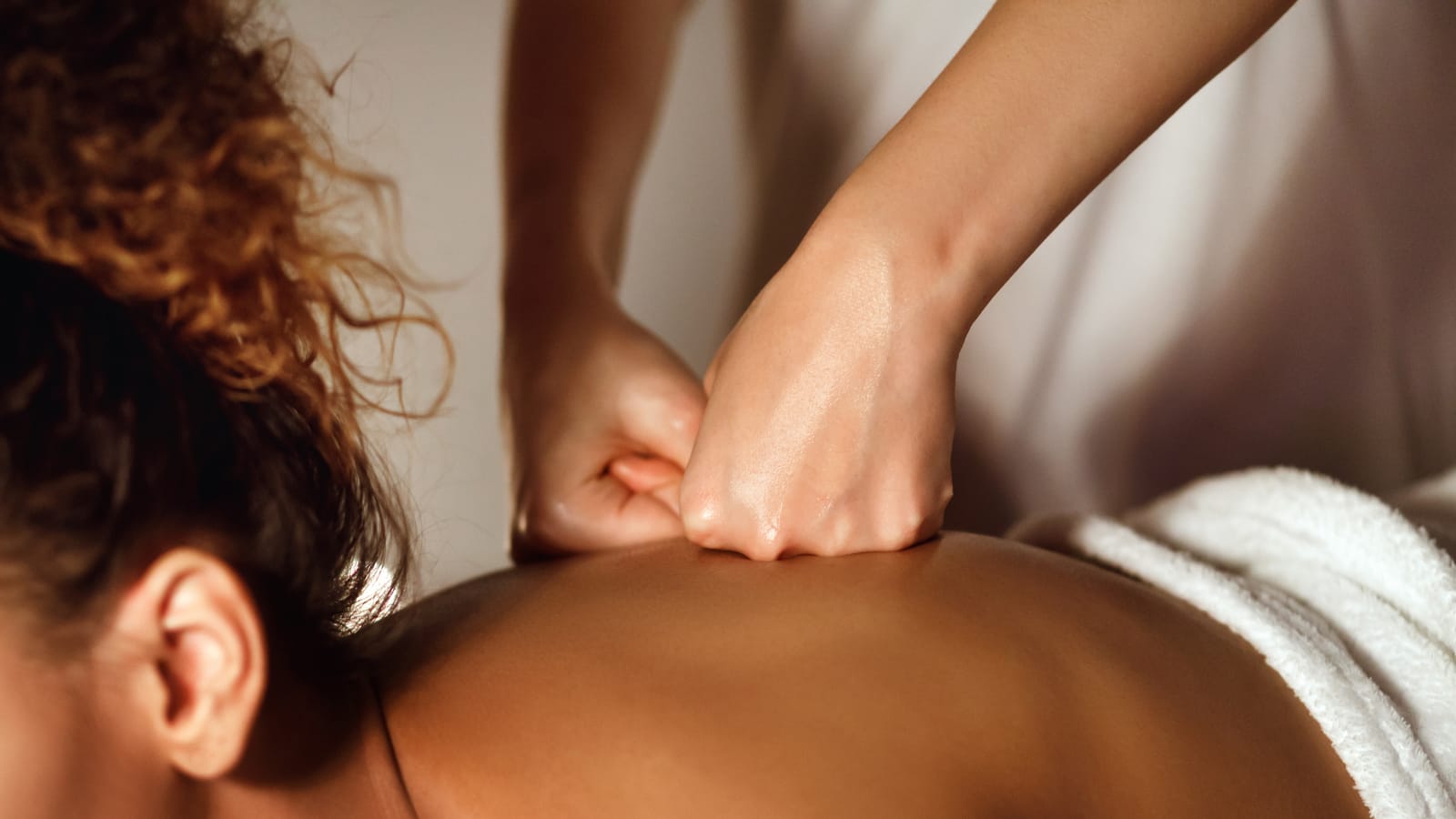
Deep tissue massage works on these structures by using sustained, slow pressure to reach through the surface layers of muscle and into the denser tissue underneath.
For the lower back, the session typically begins with lighter strokes across the entire area to warm the tissue and give your massage a clear sense of where restriction is sitting before deeper work begins.
Once the surface has softened, your massage therapist works into the quadratus lumborum using careful elbow or thumb pressure applied slowly along the muscle belly, staying parallel to the spine rather than pressing directly onto it.
The gluteal muscles are worked across their full width, with particular attention to the junction between the glute and the piriformis where tension tends to concentrate.
Piriformis release requires precise placement. Your massage therapist locates the muscle by working inward from the posterior hip, applying sustained pressure that allows the muscle to yield rather than forcing through it.
When the piriformis releases, clients often notice a simultaneous easing of referred sensation in the leg as the pressure on the sciatic nerve reduces.
Throughout the session, your massage therapist follows the pattern of tension rather than working through a fixed sequence, spending more time where the tissue is most resistant and adjusting depth based on how each area responds.
At Baan Thai Wellness, this is combined with Thai acupressure and gentle passive stretching of the hip flexors and lumbar spine, which addresses the tightening in adjacent structures that deep pressure alone cannot fully reach.
How Lower Back Tightness Affects Posture and the Rest of the Body
Lower back tightness rarely stays contained to the lower back.
When the lumbar muscles are chronically shortened, the pelvis tilts forward, which increases the curve in the lower spine and creates a compensatory flattening in the mid and upper back.
The body then recruits the neck and shoulder muscles to counterbalance, which is why people with longstanding lower back tightness so frequently also carry tension in the upper back and base of the skull.
Releasing the lower back and hips in a focused session often produces an almost immediate change in how the upper body feels, even when the upper back has not been directly worked on.
Over a course of regular sessions, this postural shift becomes more stable.
Sitting and standing start to feel less effortful, the spine loads more evenly, and the tendency to unconsciously brace through the lower back during everyday movement begins to reduce.
What to Tell Your Massage Therapist for the Most Effective Lower Back Session
The more specific you can be about your lower back before the session starts, the more accurately your massage therapist can plan where to focus.
It helps to describe exactly where the pain or tightness sits — whether it is central, off to one side, across the whole lower back, or concentrated at the top of the buttock — and what it feels like, whether that is a dull ache, a sharp pull, a burning sensation or a stiffness that is worst at a particular time of day.
Telling your massage therapist when it is worst is particularly useful.
First thing in the morning stiffness that eases as you move suggests a different pattern from pain that builds across the day and is worst after sitting, and both suggest something different again from a back that is fine during the day but aches when lying down at night.
Let your massage therapist know whether the sensation ever travels into the buttock or down the leg, and whether any particular movement, such as bending forward, twisting or walking uphill, makes it noticeably better or worse.
This information helps distinguish between tension that is primarily muscular and patterns that may involve the piriformis and sciatic nerve, which changes the approach used.
Ready to Book Your Deep Tissue Massage in Ipswich?
Lower back tightness does not have to be something you simply work around.
Focused deep tissue massage in Ipswich at Baan Thai Wellness can address the specific muscles involved, ease the referred patterns that travel into the leg, and create a more lasting shift in how your lower back feels and moves day to day.
Sessions are available Monday to Friday 10:00 to 19:00 and Saturday 10:00 to 16:00, priced between £30 and £50.
Free allocated parking is directly outside the clinic at 26 Dashwood Close, Pinewood, Ipswich, IP8 3SR.
You’re welcome to book online through the Baan Thai Wellness website or call 01473 875154 to discuss your situation before your first appointment.