Thai Head Massage in Ipswich for Head, Neck and Scalp Tension
Some days it feels like wearing a tight helmet that never comes off. Your head throbs, your scalp feels sore when you run a hand through your hair, and even your temples ache by mid-afternoon.
Most people assume this kind of tension comes entirely from the neck and shoulders, but a significant part of it often starts somewhere else entirely.
A Thai head massage works on that different source directly, which is what makes it distinct from a back or shoulder-focused treatment.
Why Head Tension Is Often a Jaw Problem, Not Just a Posture Problem
The temporalis, the muscle covering the side of your skull above and around your ear, is built for chewing, not for staying contracted for hours at a time.
When you clench your jaw, whether that happens overnight during sleep or during the day while concentrating hard on something without realising it, the temporalis holds a sustained contraction it was never designed for.
Research on sleep-related jaw clenching has found that these contractions can reach well beyond the force used in normal chewing, which explains why the resulting muscle fatigue produces genuine, sometimes severe, pain around the temples rather than mild tiredness.
This is a separate mechanism from the neck and shoulder tension that builds from sitting at a desk, and it is often the missing piece for people who have tried addressing posture and stretching without much change to their headaches.
If you wake up with sore temples or a tired jaw, or you notice your teeth are in contact when your mouth is not actually doing anything, jaw clenching is worth considering as the source rather than assuming the cause must be sitting posture alone.
The Daytime Clenching You Might Not Notice
Night-time grinding gets most of the attention, but daytime clenching is just as common and considerably easier to miss, because it tends to happen during exactly the moments you are not paying attention to your own body.
Deep concentration, a stressful email, an intense meeting, or simply focusing hard on a screen are all situations where the jaw quietly tightens without any conscious decision to clench it.
Because this happens below the level of awareness, it can continue for hours across a working day, adding up to a cumulative load on the temporalis that rivals or exceeds what happens overnight.
This is one of the reasons head tension can feel disconnected from any single obvious cause. The clenching itself was never consciously noticed, so the resulting ache seems to arrive from nowhere.
The Scalp Itself as Its Own Source of Tension
Beneath the skin of your scalp sits a broad sheet of connective tissue called the galea aponeurotica, which connects the muscles at the front and back of the skull.
Unlike the muscles of the neck and shoulders, this tissue does not move a joint. Its job is closer to an anchor point, and when the muscles it connects to are chronically tight, the whole sheet can feel taut, tender or oddly sensitive to touch across the entire scalp rather than in one specific spot.
This is why some people notice that simply running a hand through their hair feels uncomfortable during a stressful period, even though nothing is technically wrong with the hair or skin itself. The sensitivity is coming from the tissue underneath.
Working directly on this layer, rather than only on the neck and shoulders, is a distinct part of what a head-focused treatment addresses that a back or shoulder massage does not reach.
What a Thai Head Massage Session Actually Addresses
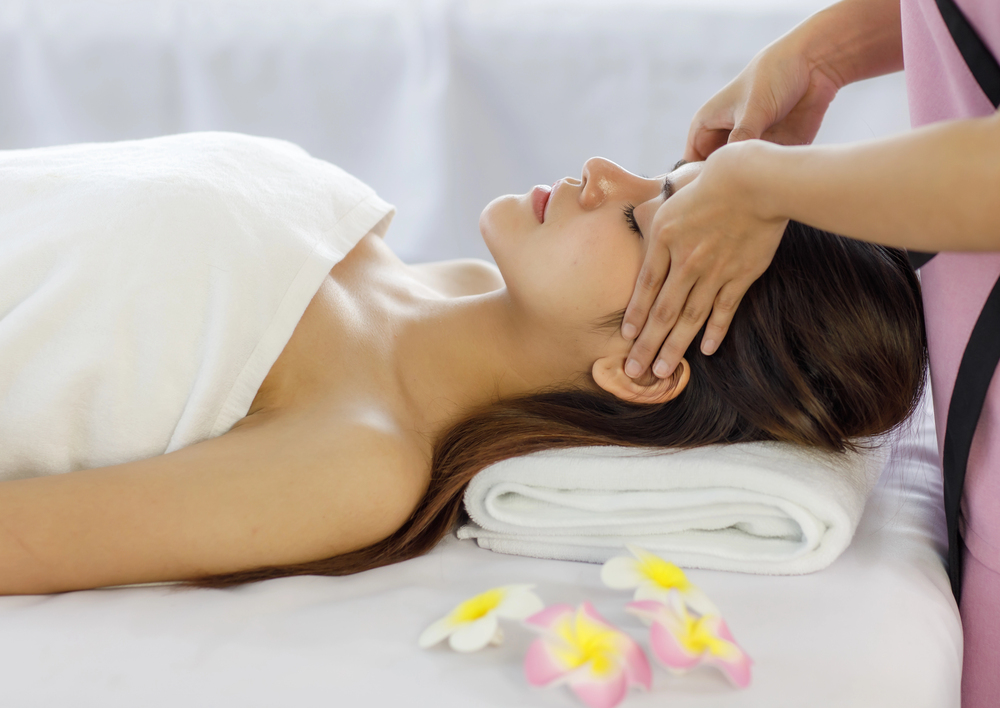
Your massage therapist works through the scalp, temples, jaw line and upper neck using sustained pressure rather than a light rub, since the galea and the temporalis both respond better to direct, held pressure than to brief stroking.
Specific attention is given to the temporalis itself, working from the hairline down toward the ear, which is often where daytime and night-time clenching concentrates the most tension.
The jaw is addressed gently along its hinge point, since releasing tension here frequently produces a noticeable easing in the temple area within the same session, given how directly the two are connected.
Work across the scalp itself follows, addressing the galea directly rather than assuming that easing the neck alone will resolve scalp tenderness, since the two respond somewhat independently.
Being Honest About Scalp Massage and Hair Health
Scalp massage is sometimes described as beneficial for hair thickness, and there is genuine research behind this, though it is worth understanding what that research actually involved before drawing conclusions about a single treatment session.
A study published through the Eplasty journal found a measurable increase in hair thickness in men who received scalp massage using a mechanical device for four minutes daily over 24 weeks, a specific, frequent, sustained protocol rather than an occasional professional treatment.
What this means practically is that a single Thai head massage session is unlikely to meaningfully change hair thickness on its own, since the research supporting this effect relies on daily repetition over months.
What a session at Baan Thai Wellness can genuinely offer is improved scalp circulation and reduced tension in the tissue during and immediately after the treatment, which is a real and immediate effect, distinct from any longer-term claim about hair growth that would require a very different routine to achieve.
Ready to Address Head Tension at Its Actual Source?
If your head, temples and scalp carry tension that neck and shoulder work alone has not fully resolved, Thai head massage in Ipswich at Baan Thai Wellness works directly on the jaw, temporalis and scalp fascia rather than assuming posture is the whole story.
The clinic is at 26 Dashwood Close, Pinewood, Ipswich, IP8 3SR, with free allocated parking outside, open Monday to Friday 10:00 to 19:00 and Saturday 10:00 to 16:00.
Find a time that suits you here.